
Articles: Fix for PageSpeed Module Causing High Server Load
 Google's PageSpeed Module has had a lot of praises heaped upon it for its ability to perform a myriad of performance optimizations to help web servers deliver content quicker. I had tried it in the past on my servers (running CentOS & Apache) but was always hit by heavy, unacceptable server loads. So I've always had to just go back and disable it. That was actually a couple of years ago, so recently I gave it another go. I downloaded the latest beta version (mod_pagespeed version 1.9.32.10-7423). Installation was easy, though I....
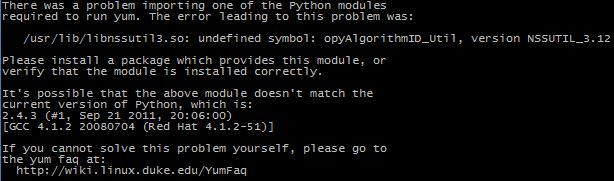 So I was looking to upgrade PHP on one of my servers running CentOS 5.7 from PHP 5.3.x to PHP 5.5. I wanted to get it to 5.6 actually but unfortunately there is no such package available on Webtactic.com. But anyways I began the process by running the command:
 I ran into a weird problem, so I thought, with MySQL today. I have a MySQL table (let's call it "verizon_fios" for our example) with a pair of integer columns (promotion_code_a and promotion_code_b) that I want to do some calculation with- specifically subtracting one number from another.
 I was using mysqldump to backup mysql data from one server to another. It was working well until recently after I added a few more lines to my command line backup script- basically to backup more tables. In the script I have individual lines to backup single tables in this example format:
 Many of our websites allows people to make comments, and we get an email whenever there is a new comment, and that email will contain the domain name so we know where it came from. Recently I noticed that there were some comments from a strange domain that does not belong to us. For the purposes of this article I'm calling the unauthorized domain "hacker-domain.jerk", and that our actual domain is "coolcomputing.com" hosted at the IP address of 1.2.3.4. What was happening was that someone nefarious set up their domain name to DNS point at....
 One of our websites all of a sudden had visitors through Google via it's name server subdomain of NS1. For instance, people come coming in through (for instance) ns1.Coolcomputing.com instead of www.coolcomputing.com for some reason. Of course, we don't want any sort of duplicate content/listing on search engine results, so what we need to do is to redirect those sub-domain names to the proper one (www). Here's how we did it via Apache to do a permanent 301 redirection (you need tje Apache rewrite module turned on)- example httpd.conf virtualhost configuration chunk below:
 On one of our Linux servers running CentOS 5 I wanted to run a cron job on a script that download a certain file every 15 minutes, but the source hosting the file only allows up to a certain downloads daily. Therefore I needed to get some sort of logic in the bash script so that it skips certain hours. To get the current hour and store it in a variable, I had in the file:
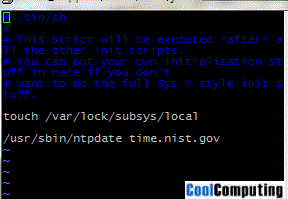 A Linux server, running CentOS 5 and hosting one of our PHPBB forum sites had to be rebooted last night. Afterward no one could post anymore because everyone was getting the following error message:
 I was editing some files with vim on a new Linux server and was getting frustrated that everytime I try to type in or paste in the British Sterling/British pound symbol of £ it is prefixed with a strange character of Â. I did not have this problem with the pervious server I was using, which is based on FreeBSD. And when I tried to delete that character it deletes the £ character as well.
  Recently I switched the web hosting service provider, and noticed these odd black diamond shaped characters with a question mark in the middle on my web pages. Characters such as the double quote and the copyright symbol are all being replaced by this foul black diamond character with the ? in the center. Doing some research, it seems that happens because you have a character set, or charset, that does not match between the database, web server, and PHP.